
Water Injection Molding Makes Hollow Parts Faster, Lighter
Coring out thick sections with cooling water is not only faster than gas-assist molding, but it makes thinner walls and smoother part interiors. The technology is very new, but it is moving fast to wider commercialization.
Water-assisted injection molding is the newest way to mold hollow or partly hollow parts.


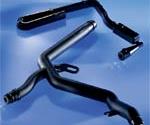
Water injection looks promising for glass-filled nylon automotive ducts, like this part molded by Engel at the K 2001 show.

Smooth internal part surfaces is one of several advantages water has over gas injection. (Shown here, a sample of a PP rackethandle from the IKV in Germany.)
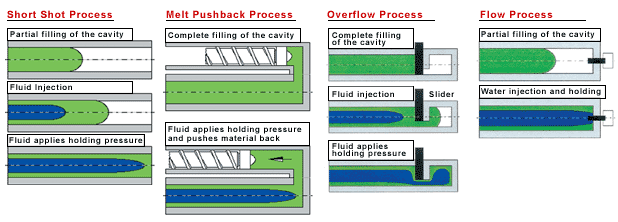
Four different approaches to water injection differ in scrap generation and surface quality. (Source: Engel)
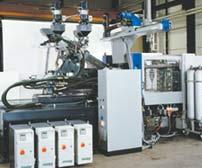
WIT systems like Battenfeld’s Aquamould (far right) are stand-alone devices for water treatment, accumulation, injection, and evacuation. They control water temperature, pressure, flow rate, and sequencing.
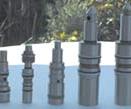
Leaks are more of a concern with WIT than with gas-assist. PME designed 18 proprietary valve designs that maintain water pressure and don’t let water slip between the mold and part surface.
Water-assisted injection molding is the newest way to mold hollow or partly hollow parts. It’s basically similar to gas-assist molding as a means to core out thick sections. But water-injection technology (WIT) comes with a big advantage: direct cooling inside the part. The thermal conductivity of water is 40 times greater than that of gas, and water’s heat capacity is four times greater than gas. “With the cooling capability of WIT, cooling cycle times can be reduced to only 25% of that of gas,” says Helmut Eckardt, technical director for low-pressure injection molding at Battenfeld Injection Molding Technology in Meinerzhagen, Germany.
But the potential for faster cycles is only part of the story. “There are many reasons why the technology is attractive,” says Friedrich Westphal, head of Project Management Engineering (PME), a German supplier of WIT systems. He says that if done correctly, WIT can yield thinner, more uniform part walls, which adds to material savings. WIT’s ability to produce a smooth internal part surface, which is much more difficult with gas assist, makes injection molding much more competitive with blow molding. Some sources also believe WIT can produce larger void spaces and longer hollow sections in parts than gas can. A. Schulman in Germany helped produce a prototype PP shopping cart that had a water channel 3 meters long!


Water injection molding burst onto the scene in a big way at last fall’s K 2001 show in Dusseldorf, Germany. R&D on the process has been under way at a number of European injection machine suppliers, independent makers of gas-assist equipment, resin companies, and others. The impetus for much of this activity was a 1998 report on WIT research at the Institut fur Kunststoffverarbeitung (IKV), a plastics processing development center in Germany. The IKV continues active development of the process.
WIT is already in limited commercial use in Germany and several projects are in active development. But because WIT is so new, a number of technical questions remain to be answered. Researchers are seeking to define the proper water temperature, pressure, and flow rate, as well as the effect of internal water quenching on resin crystallization and molded part properties.
There are also numerous hardware questions: “The injection press and processing are unchanged in all aspects up until it is time to inject the water,” says Jorg Dassow, manager of application technology at Ferromatik Milacron in Germany. “At that point there is a question of how and where to inject the water, how to evacuate the water, and the related tooling and control technology needed to accomplish it.” Other issues center around pin and valve design and mold modifications. All of these are reasons why knowledgeable parties are quick to point out that WIT should not be considered a drop-in substitute for gas assist.
Who’s involved
A number of suppliers offering systems for gas-assist have modified their equipment for WIT use. Currently, there are seven firms offering WIT technology. These include three systems from press suppliers: Aquamold from Battenfeld, Watermelt from Engel, and AquaPress from Ferromatik Milacron Europe. Independent sources of WIT equipment are Alliance Gas Systems, Cinpres Gas Injection, Maximator in Germany, and Project Management Engineering (PME) in Germany. One materials supplier, Rhodia Engineering Plastics in Germany, developed its own WIT system for materials-testing purposes, but does not intend to offer it commercially. All WIT R&D is occurring in Europe at the moment, but suppliers expect the draw of lower cycle times to attract users in North America.
“Water is a niche process right now, so it is important that no one promises too much, ” cautions Oliver Phann schmidt, head of the injection molding department at the IKV. He recalls that when gas-assist first arrived on the scene, it had a tough incubation period with processors, who had little technical help when they tried to take the technology into new areas of molding.
Why water works
The chief difference between water and gas is that gas is compressible, while water is not. When injected into the melt, the leading edge of the water forms a solid boundary or highly viscous membrane. The membrane forces molten material forward, instead of the polymer forcing the water to the side. The primary reason for this action is the higher viscosity and incompressibility of water compared with gas. This viscous front acts as a ram that cores out the part. The front also cools the melt as it is pushed down the mold cavity by water pressure. “Gas-assist operates at a pressure of 300 to 2500 psi, while water-assist generally operates in a range up to 4350 psi,” says Kai Jacobsen, manager of machine sales and technologies for Engel.
“Gas can migrate into solution with the polymer. Water is a different story,” notes Jacobsen. If gas permeates the polymer, it can roughen the inner surface of the part when the gas migrates out again. However, Steven van Hoeck, v.p. of sales at Alliance Gas Systems, believes the rough inner surface could be due to too much pressure on the gas or leaving the gas in the part too long—both causes for the gas to begin to act as a foaming agent.
Suppliers agree on several other differences between gas and water injection. Gas, unlike water, can branch into smaller flow streams inside the part, creating an undesirable fingering effect. The unpredictability of gas behavior makes it very difficult to control wall thickness, while water makes wall thickness uniform and repeatable. And has already been noted, gas does not cool the part.
(There is, however, a new gas-assist technology, called KoolGas, developed by the Warwick Manufacturing Group, part of the Advanced Technology Centre at the University of Warwick in England. It can increase the cooling effect of gas by cryogenically cooling it as far as -292 F, and/or circulating gas through the part at a high rate of up to 75 liters/min.)
For shrinkage and sink reduction, molds can be pre-pressurized with gas before melt is injected, or gas can be introduced between the non-appearance side of the part and the mold. Water, however, would likely mar the surface of the part and couldn’t be used for that purpose.
“Overall, we do not see competition between gas-assist and water-assist,” says Mark Paddock, v.p. and general manager of Cinpres Gas Injection. “Generally speaking, thicker parts and ones with longer flow paths could be good for water assist.”
Molders looking to apply WIT to large multi-cavity tools should be cautious, suppliers warn. They recommend the process for tools having no more than four to six cavities. “Molders shouldn’t think about molding with a 12- or 16-cavity tool, because process control will be much more difficult,” says Engel’s Jacobsen.
Ready to make a splash
A number of companies expect the first users of WIT to be gas-assist molders seeking to capture the potential for lower cycle times. Tubular parts, automotive fuel lines and other fluid systems, handles, roof racks, fascias, bumpers, door handles, clutches, and steering-column supports are some of the areas where suppliers are hopeful the technology will get its first major toehold. Other products being considered include baby strollers, handles for kitchen items, office furniture, shovels, brackets, and general fittings.
Thilo Stier, technical director at A. Schulman in Germany, says the first commercial use of WIT was an all-plastic shopping cart made by Sulo GmbH in Herford, Germany. The project started in 1998. It used Schulman’s PP and PME’s WIT technology to mold a part with three water channels from 20 to 60 mm diam and 800 to 1500 mm long. The PP trolley had previously been molded with gas-assist in 280 sec, while WIT took just 68 sec.
Engel’s Jacobsen says a chain-saw handle made of a 30% glass-filled nylon was molded in 30 sec with WIT vs. 61 sec with gas assist.
Ferromatik reports that a PP part produced in a single-cavity test mold took 60 sec to make as a solid part, 40 sec with gas-assist, and 30 sec with WIT.
At IKV, a two-material sports racket was made using Battenfeld’s Aquamold process. It is a three-shot process with two materials plus water. The water flow path splits to core out the racket frame. The first shot molds the handle and frame of 20% glass-filled PP from Schulman. The second shot makes the web of unfilled PP. The third shot injects water into the frame. The incompressible water supports the hollow frame while the web is being injected, notes Battenfeld’s Eckardt.
PME cored out 6-8 mm diam. glass-filled nylon pipes with gas and with water. The wall of the gas-assist part was two to three times thicker than with water. “WIT trimmed the walls to about 2 mm in a shorter cycle,” says Westphal. The WIT part showed improved mechanical properties even with less material, he adds.
Early successes
WIT technology has already found some success. PME appears to lead all other suppliers: In 2001, PME had 12 systems operating commercially or in advanced projects. The firm has received an order from a Dutch firm for a system to produce 960,000 appliance handles and to convert production of a another hollow handle from steel to plastic using WIT. The latter project involves 360,000 units. PME is also doing tests for BMW to convert an automotive duct from gas-assist to WIT.
Maximator’s Rupprecht says its first serious molding applications with water will be considered by a molder in coming weeks. “But we will look to do it with gas first,” he adds. Alliance has eight to 10 candidates. “We are selecting only two or three for further evaluation of WIT, with the rest likely going to gas-assist,” says van Hoeck. Alliance has done WIT trials with makers of personal water craft. The 2-ft-wide part has massive internal sections hollowed out with gas-assist, but the gas leaves a 1-in. wall. “With water, we can trim the wall thickness considerably and cut cycle times by 2 min,” says van Hoeck.
Battenfeld has about 10 Aqua mold projects in the works, and Engel has eight to 10 projects in trials. Cinpres and partner Factor have five projects moving toward commercialization. All are tubular products for the auto industry. Each is being evaluated for either gas or water.
Four process approaches
WIT can be applied in one of four processes. The sequences, similar to the process variations seen with gas-injection technology, vary by filling of the polymer, introduction of the water, and evacuation of the water by gravity or air.
- Short shot: Also called the bubble or blow-up process, it is executed by partial filling of the mold cavity with melt. Water is injected into the mold before the end of melt injection, pushing the material to the end of the cavity for final packing. Valves close off melt from the injection unit and water from the pin. A release valve for the water opens allowing water to drain from the part. A valve mounted at or near the end of fill can facilitate water evacuation using compressed air.
This method is considered good for very thick parts. It involves no wasted material and no regrind. Entry and exit points for water (and air) can be at/near the same point. Disadvantages relate to the tight control required. Too little material can lead to water bursting through melt into the mold. Water injection pressure must be higher than the melt pressure to push it to end of fill. The switchover point from resin injection to water injection may cause hesitation marks on the surface of the part, so a Class A finish may not be feasible. Also, material at the end of a short shot is likely to form a thicker section that could lengthen cycle time.
- Pushback: Melt completely fills the cavity. Opening a water pin located near the end of melt fill pushes the excess melt back into the head space in the injection unit. Advantages of this approach include the absence of scrap material and ability to achieve Class-A finish. As for disadvantages, it requires a special nozzle and check ring to accommodate material coming back into the injection unit. Users must be careful not to let water penetrate into the injection headspace (that could be a big problem with hygroscopic materials like nylon). Every part of the process must be under controlled pressure to get a consistent, known amount of material back into the molding unit. The returning material may be of a temperature or pressure different than that still in the barrel, creating process variables that may influence the next shot. Separate air and water delivery systems are required.
- Overflow: The mold cavity is completely filled with melt and closed off by a valve. A separate pin then opens in the mold for water injection, while simultaneously, a valve at the end of cavity fill opens a path from the main cavity into a secondary or overflow cavity. The incoming water displaces melt, which is pushed into the secondary cavity. The secondary valve is closed for hold and pack. Water can be expelled through gravity or evaporation.
This approach reportedly can provide a Class A surface. It is closest to conventional molding, offering a wider processing window. It also requires lower water pressure than the short-shot method. On the downside, displaced material from the core has to be recycled. Secondary trimming is needed to separate the finished product from the excess material in the secondary cavity.
- Flow process: A combination of the short-shot and overflow methods flushes water through the part for enhanced cooling. The mold cavity is partially filled, then water is introduced, pushing the material to the end of fill. A special valve opens at the end of fill, and the water breaks through the melt and streams through the valve into a water-recirculation circuit. Advantages are material savings and a high rate of cooling. Disadvantages include a blemish at the tip of the part. Also low pressure could cause water to seep between the inner mold surface and outer part surface.
A common factor in WIT processes is the need to purge the water. Gravity works in some situations, but some suppliers advocate sequencing WIT with gas-assist. Alliance Gas Systems says its WIT systems include a pressurized gas purge. For sensitive materials, Alliance can supply a gas-assist system with a secondary water injection, followed by a gas purge. Suppliers remark that the entire process of injecting and evacuating water takes just a few seconds.
What’s available
Commercial WIT systems consist of stand-alone water-delivery hardware with pressure, temperature, and flow controls. The control also operates water and air valves in the tooling. Many systems have water filtering, as well. Each company also has its own specialized water-injector nozzle or pin. Some injectors can handle both water and purging air. Some perform dual service by passing water both into and out of the mold. Maximum water-pressure and flow rate capacities also vary from system to system. Most systems require a signal from the injection unit to initiate the cycle.
- Alliance Gas Systems offers the Hydrojection WIT system with the HMP-3 multi-fluid electronic injector. It injects both water and gas. “The fastest way to purge the water is with air,” says van Hoeck. The pin is used for water pushback, too. The Alliance system recirculates tower water at 60-70 F. It has water injection-pressure capability of 5000 psi, although 1000 to 3000 psi are commonly used.
- Battenfeld’s Aquamold system is derived from its Airmould gas unit. The mobile unit has a touchscreen control. It can also be controlled through a Unilog B4 system on the injection press. The modular system offers pressure-generating units of different sizes capable of water pressures up to 4350 psi and flow rates of 60 liters/min. Water pressure can be profiled up to nine steps. The compact pressure-control modules can be mounted close to the mold. Water can be injected and purged through the same opening. Water can also be purged by gas injected through another module. One pressure-generating unit can serve several molding machines.
- Cinpres Gas Injection is currently offering a WIT system developed by Factor Maschinen & Anlagentechnik GmbH of Hainburg, Germany. CGI is developing its own system that will have a different design, but no details are available. The Factor WIT system provides more than 2900 psi water pressure and flow rates to 1 liter/min.
- Engel’s Watermelt process is designed to circulate water through the part. A new mobile water-injection device has a maximum pressure of 2900 psi and flow rate of 7.9 gal/min.
- Ferromatik Milacron offers both push-back and overflow processes. Its Aquapress technology, based on its Airpress III system, delivers water at about 4350 psi. The firm is evaluating the merits of pressures up to 14,500 psi.
- Maximator’s WID-Technik system is based on its GID gas-assist technology. The water-accumulator system can provide flow rates up to 23 liters/min at up to 7250 psi. Water pressure can be set in a 10-step profile. Maximator offers a spring-loaded water injection nozzle that opens under hydraulic pressure and closes via the spring. (The current design is said to be an improvement over the initial model, which did not always close completely.) The firm is testing new all-hydraulic nozzle designs that it is developing with Bayer AG in Germany.
- PME designed a touchscreen PC-based control system for water injection as well as water circulation for mold-temperature control. It also controls the hot-runner system. PME also offers 18 different nozzle designs for water injection. The standard 27/210 system delivers 27 liter/min at up 3480 psi, while the 130/150 model can deliver 130 liter/min at 5000 psi. The WIT Power module 27/210 controls both water and compressed-air delivery.
Materials in testing
Testing and development of materials for WIT is being conducted in Europe by resin companies such as BASF, Bayer, DuPont, Rhodia, and A. Schulman. The two leading candidates for early commercial uses are nylon 66 and PP. Also being tested are polycarbonate, ABS, PC/ABS, HIPS, PBT, acetal, and copolyester TPEs.
DuPont, for example, reports promising WIT results with its Zytel EFE73-92 30% glass-filled nylon 66 in making a 1-in.-diam. cooling duct for BMW. “This part is currently made with gas-assist in 60 sec, but we have tested the same material in the same mold with WIT in 35 sec,” says Bender. DuPont has also looked at other thermoplastics such as its Hytrel polyester TPE. “We think WIT may be used across our product line, including acetal and PBT.” Bender adds, “We’ve been working with WIT technology for a year and a half. I expect to see commercial developments in automotive next year.”
Some industry sources have raised questions whether WIT could cause such rapid quenching of crystalline resins as to change the crystalline structure and thus the performance properties of parts. Information obtained so far from materials suppliers does not indicate any perceptible effects on material microstructure. On the other hand, more macroscopic effects do occur. Crystalline materials can be a problem with WIT because they form a skin so quickly when cooled, says Stier of A. Schulman. He says materials should be tailored for slower crystallization to yield smoother inner surfaces and fewer hesitation marks on the outside. Since 1998, Schulman has had six commercial WIT applications running its nylon, ABS, and PP materials, and eight more projects are in the works.
DuPont has found that rapid quenching of crystalline nylons can cause shrinkage voids inside the part wall, which can compromise structural properties, according to Klaus Bender, process supervisor for DuPont’s Engineering Polymers technical center in Switzerland. DuPont and Engel tried injecting warmer water to counteract this problem, but using water up to 140 F had no effect on nylon, Bender says. This result appears to indicate that materials modification for slower crystallization may be a better solution.
This prototype nylon automotive duct molded by Rhodia indicates how WIT can produce wider hollow sections with thinner walls than can gas-assist. Resin suppliers are evaluating grades for WIT.


Related Content

Compact Hybrid Injection Molding Machine Launched
Sumitomo Heavy Industries Ltd. (SHI) has introduced the iM18E, promising the smallest footprint in 20-ton machines.
Read More
Injection Compression Molding as Alternative to Thermoforming
Arburg will show its all-electric Allrounder 720 A press utilizing injection compression molding to create thin-wall IML cups from PP.
Read More
Slimmer All-Electric Press Debuts
A slimmed-down version of Engel’s all-electric, e-mac injection molding machine is among eight displays, which also include LSR micromolding, quick mold changes and a cube mold.
Read MoreAbsolute Haitian Brings Next Generation of Presses to Orlando
Absolute Haitian says Generation 5 of the servo-hydraulic Haitian and electric Zhafir machines lines emphasize efficiency, performance and intelligence.
Read MoreRead Next

Processor Turns to AI to Help Keep Machines Humming
At captive processor McConkey, a new generation of artificial intelligence models, highlighted by ChatGPT, is helping it wade through the shortage of skilled labor and keep its production lines churning out good parts.
Read More
Why (and What) You Need to Dry
Other than polyolefins, almost every other polymer exhibits some level of polarity and therefore can absorb a certain amount of moisture from the atmosphere. Here’s a look at some of these materials, and what needs to be done to dry them.
Read More
Lead the Conversation, Change the Conversation
Coverage of single-use plastics can be both misleading and demoralizing. Here are 10 tips for changing the perception of the plastics industry at your company and in your community.
Read More