‘Skew’ Rolls for More Uniform Sheet
Extrusion
New feature aimed at thin-gauge PP sheet.

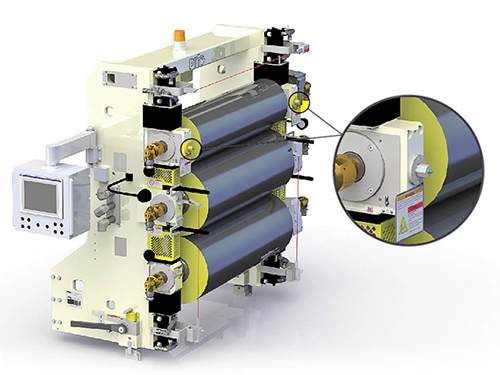
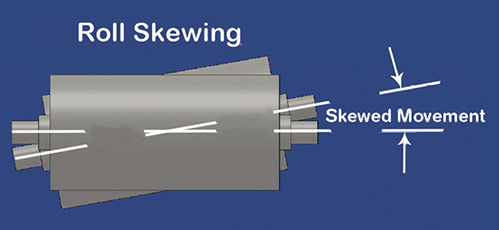
PTi’s Roll Skewing mechanism allows operators to adjust each side of the top roll ±0.75 in. (see top images for points of adjustment). This results in the center of the top roll remaining centered over the center of the middle roll, while the deflection of the top roll will “wrap” around the middle roll. Bottom image shows range of skewed movement.


Processing Technologies International (PTi) LLC, Aurora, Ill., has developed a special device to compensate for roll deflection that commonly occurs over time in sheet-roll stands. PTi’s Roll Skewing mechanism allows operators to fine-tune the position of the lead roll on a horizontal stack—or the bottom roll on an up or J-stack, or the top roll in a downstack—to mitigate the impact of roll deflection and allow processing sheet with more uniform thickness across its entire width.
When placed under high loads, typical steel/chrome rolls used in standard sheet stacks will eventually pull away from each other in the center, creating a gap between the top two rolls that is wider in the center than at the edges. As a result, the film will be thicker in the center than at the edges.


Roll-stack suppliers have used various methods to counter this phenomenon over the years. One common approach is to pre-grind a camber into the top roll to create a “crowning” effect. While this method has been effective for the most part, it is limited to a narrow range of products because the geometry of the camber is inherently fixed, according to James Johnson, a senior v.p. and technical consultant with PTi who formerly was senior v.p. of sales and marketing.
Another approach to counteract roll deflection is roll bending, whereby the top roll bends in a direction opposite to the load so that it conforms to the middle roll—creating a “smile” pattern between the two rolls that is said to minimize the effects of deflection. One such roll design, the ContraBend, was developed and patented in 1996 by New Castle Industries (now part of Nordson Xaloy, Pulaski, Va.). “This technique also limits the overall effectiveness across a wide operating range,” Johnson states. “Roll loads less than 800 PLI are required, due to the spring constant and mechanical limitations of the operating window for this type of roll design.”
PTi’s patent-pending device, on the other hand, gives operators the flexibility to skew each side of the top roll by ±0.75 in.
While roll skewing itself is not new, PTi’s method reportedly is. It employs a cross-axis positioning of the roll such that the roll deflection is “wrapped” about the mating roll to create a uniform gap over a wide operating range. PTi recommends the technique for processing thin-gauge materials such as PP because of the system’s adjustability over a wide range of deflection patterns and gauge targets. PP has been successfully run down to 0.012 in. using skewing adjustments, Johnson says.
On the PTi device, the bearing assembly mounted to the chrome roll journal is housed within, and keyed to, an outer housing. The machine-direction position of the bearing assembly within the outer housing is controlled by a threaded push/pull device mounted on the front cap of the outer housing. Using this device to adjust one bearing assembly forward, and the other backward by the same amount, causes the center of the top roll to remain centered over the center of the middle roll, while the deflection of the top roll will “wrap” around the middle roll.


Related Content

What to Know About Your Materials When Choosing a Feeder
Feeder performance is crucial to operating extrusion and compounding lines. And consistent, reliable feeding depends in large part on selecting a feeder compatible with the materials and additives you intend to process. Follow these tips to analyze your feeder requirements.
Read More
Shredding Thin Film: How to Do It Right
While many processors recoil at this task, a little know-how in shredding equipment, processing, and maintenance should add the necessary confidence.
Read More
How Polymer Melts in Single-Screw Extruders
Understanding how polymer melts in a single-screw extruder could help you optimize your screw design to eliminate defect-causing solid polymer fragments.
Read More
How to Select the Right Tooling for Pipe Extrusion
In pipe extrusion, selecting or building a complementary set of tooling often poses challenges due to a range of qualitative factors. Here’s some guidance to help you out.
Read MoreRead Next

Lead the Conversation, Change the Conversation
Coverage of single-use plastics can be both misleading and demoralizing. Here are 10 tips for changing the perception of the plastics industry at your company and in your community.
Read More
For PLASTICS' CEO Seaholm, NPE to Shine Light on Sustainability Successes
With advocacy, communication and sustainability as three main pillars, Seaholm leads a trade association to NPE that ‘is more active today than we have ever been.’
Read More