
NPE News Wrap-up: Resin Dryers
At least 16 companies introduced new dryers at the big show in Chicago. The new models span a range of drying technologies, but most sport features that save space and cost and make the dryers simpler and more reliable.


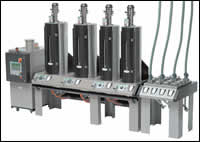
ResinWorks from Conair is a highly flexible, customizable new system of multiple drying hoppers on a single “sled.” It permits quick material changes and precise control of individual hoppers.
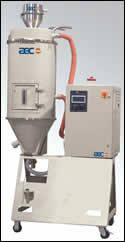
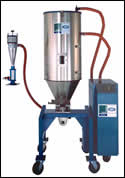
All-stainless hoppers are used on new portable drying/conveying systems like AEC’s Nomad II (left) and Universal Dynamics’ GS model (below).
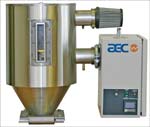
Motan brought out its first compressed-air dryers, including this LCA 30, which has an optional “coalescent” membrane.
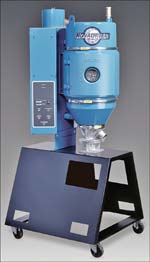
Matsui’s new MJ3 portable dryer/loader is more efficient, more compact, and more economical than previous models.
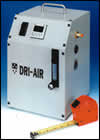
Dri-Air’s new Micro Dryer is aimed atmicromolding and dries as little as 5 g.
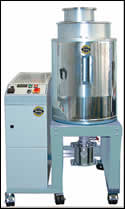
Some new compact units like Sterling’s STT40 have dryer sections resembling a small mold-temperature controller.
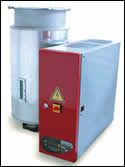
Wittmann’s Drymax 30 is its first machine-mounted dryer.
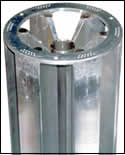
Thoreson McCosh puts heat pipes inside the aluminum fins of its new hot-air dryer to distribute heat evenly.
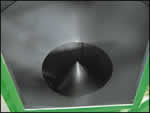
Solid-cone hoppers are easier to clean than perforated cones. (Photo: Foremost)
Resin dryers were the most numerous new entries in materials-handling equipment at NPE. They included every possible size and type, from conventional desiccant models to hot-air, vacuum, and compressed-air types—with or without drying membrane. Suppliers have focused their attention on reducing energy usage, maintenance, and up-front cost while also making the dryers more self-regulating and foolproof.
Among the benefits most commonly cited for the new models are smaller footprints, easier cleanout, all-stainless construction, and increased drying speed and efficiency. A number have loading and conveying integrated with the dryer. New controls range from ultra-simple to full-featured, but even the latter are said to be easier to use than ever. Touchscreens dominate, and several units can automatically drop temperature and air flow when a drying hopper is not in use to prevent overdrying or degrading the resin and wasting energy.


Membrane dryers
NPE 2003 saw the arrival of the first competitors for the NovaDrier that Novatec introduced at NPE 2000. It was a new type of dryer that uses heated compressed air and a special moisture-removal membrane that is quite different from a standard desiccant. There is no separate regeneration cycle, since the membrane purges itself automatically and continuously. This simple design has no moving parts and is said to save energy and dry very quickly. It even works for PET, according to Novatec. However, it appears to be limited to small and medium sizes because the special membrane is expensive. Novatec has sold about 700 of these patented dryers.
This year, both AEC and Sterling’s new Material Handling Div. introduced compressed-air dryers with a “reverse-osmosis” membrane. AEC’s ACM Series and Sterling’s SMD Series come in models with capacities of 30 and 60 cfm (30 and 60 lb/hr). They cost the same as standard dryers but are more compact, suiting them to machine mounting. They reportedly achieve –40 F dewpoint and heat up to 300 F (400 F optional), so they’re not suitable for higher-temperature resins like PET, say AEC sources.
Motan offers an optional “coalescent” membrane with its new LCA compressed-air dryers, described in the next section. The membrane is standard on the company’s new Micro Dryer, whose glass-bodied hopper holds about 1 lb.
Meanwhile, Novatec came out with two new control options for its NovaDriers. The Energy Saver monitors the difference between hopper inlet and outlet temperatures with an optional thermocouple. If the hopper is empty or resin flow stops for any reason, the “Delta T” becomes zero and the controller shuts off the compressed air and booster heater. If the hopper returns to active use, the air and heat come back on automatically. This option is also available on desiccant dryers that have the NovaTouch touchpanel PLC.
The Moisture Manager option, already available on NovaTouch-equipped desiccant dryers, is for critical medical and automotive parts that require precise dewpoint control. For example, it is said to prevent overdrying of nylons and certain polyesters. The user dials in the desired dewpoint, and the unit senses the dewpoint of the air leaving the hopper. The Moisture Manager varies the proportion of fresh compressed air to recirculated air to maintain the dewpoint target within ±1° F, the company claims.
More non-desiccant dryers
Another type of dryer that first appeared at NPE 2000 is the vacuum dryer from Maguire Products. Maguire has sold around 500 of these Low Pressure Dryers (LPDs), and at NPE 2003, Maguire unveiled the largest model to date, the LPD-1000. It handles 1000 lb/hr, five times the capacity of the next largest size.This is the first LPD model suitable for large-volume PET processors. Because it uses only vacuum to pull moisture out of the resin, the LPD reportedly requires only 20% as much energy and one-sixth as much drying time as standard dryers. It also permits much lower drying temperatures—for example, 300 F for PET vs. the usual 350 F.
There’s more news in compressed-air dryers, as well. Both AEC and Sterling introduced straight compressed-air dryers similar to their new models that have a membrane. These models (AEC’s AC Series and Sterling’s SCD Series) reduce the drying-air dewpoint by 20° F.
Comet Automation Systems is now the exclusive distributor of the ERD Baby, Junior, and Senior lines of compressed-air dryers from Fasti-Austria. They achieve –40 F dewpoints and come in sizes from 2 to 3000 lb/hr.
Motan brought out its first compressed-air dryers, Models LCA 15 and 30, which are aimed at low throughputs. They have bin capacities of 15 and 30 lb, respectively, and use 2.5 to 9 cfm of compressed air. These throat-mounted models reportedly can achieve dewpoints of –13 F (or –40 F with the optional membrane).
The Autoload Div. of Universal Dynamics showed a new and much larger series of compressed-air dryers called AutoDry II. The previous range went up to 120-lb hopper capacity. The new units go from 200 to 800 lb. Heating capacity is to 400 F.
Thoreson-McCosh has a new hot-air dryer that reportedly can process ABS at 20 to 30 lb/hr and PET at 60 lb/hr. It uses heat pipes to distribute heat rapidly and evenly (±1° F) from top to bottom. It reportedly gets material up to drying temperature in 30 min or less. (The heat-pipe approach is also used in hot-air Speedryers from Canam Manufactured Products.)
Also new is Matsui’s model MGD, its first hot-air dryer/loader combination. It has a stainless hopper and line-purge capability.
Desiccant dryers galore
New desiccant dryers, from micro to maxi, were also plentiful at NPE. A number of them came with upgraded controls and/or integral loading/conveying systems.
- AEC’s new AD Series of mini cabinet dryers has a dual-bed, closed-loop design and “off-the-shelf” microprocessor controls with autotuning PID temperature control as standard. Drying temperatures go up to 300 F (400 F optional). Enclosed cabinet style provides maximum safety. Blower ca pa cities are 15, 30, or 60 cfm.
- AEC showed its largest desiccant central dryer to date, the new AD-3000, which has 3000 cfm of air flow and AP-1 PLC control with touchscreen. Gas-fired heaters are op tional.
- New Nomad II portable drying systems from AEC integrate dry-air conveying on a single cart. The all-stainless systems include an AD Series desiccant dryer and touchscreen PLC controls. They can serve one or two machines.
- Also new from AEC is the AP-2 dryer control with Allen-Bradley PLC and touchscreen. It shows set and actual temperatures and actual dewpoint as well as the high-level alarm setting. An auto-shutdown sequence is preprogrammed.
- Bry-Air Systems has broadened its line with the new EZ-Dry system, which has a desiccant rotor instead of discrete beds and a fluted instead of beaded desiccant media. It’s said to allow greater air velocity to pass through the desiccant, resulting in faster drying from a smaller, lighter unit (capacities up to 600 lb/hr). Continuously rotating desiccant eliminates dewpoint spikes. Also, the fluted media reportedly lasts twice as long as typical beaded media and costs less to replace.
- Available on the EZ Dry and all Bry-Air models is the new optional Smart Dry controller. The microprocessor-based diagnostic controller has a seven-day timer and ability to maintain a set dewpoint. It monitors dewpoint, process and regeneration temperatures, return air temperatures, and various alarm functions. It can also be monitored remotely.
- The latest from Comet Automation Systems is the FCD-10100 honeycomb desiccant dryer with integral hopper loader and dry-air conveying capability. It has microprocessor control, 100-lb/hr capacity, and ability to serve two machines.
- Conair brought out the D Series of small dryers for up to 100 lb/hr. These unusually compact models resemble a mold-temperature controller in shape and size (35 x 17 x 27 in.). They use Conair’s standard indexing desiccant carousel. Prices start at $2800 and go up according to three levels of optional controls. The basic DC control has a simple LED display of set or actual process and regeneration temperatures. It also indicates a high-temperature alarm. The mid-level DC-1 control has simultaneous LED display of set and actual temperatures, various alarms, an alarm history to help with diagnostics, and auto-start countdown timer. The full-featured DC-2 control has an LCD display of operating status, set-up parameters, diagnostics, alarm log, event log, and other information. An extra LED display lets the user give added visibility to any critical parameter. It also has a membrane keypad and field-bus communications.
Conair’s major debut in drying was the ResinWorks central dry ing/blending/conveying system. Each is custom configured from a menu of standard components. Up to five drying hoppers are mounted on a single “sled” together with heaters, controls, dry-air manifolds, and purge valves. Each hopper can be sized for multi-machine/long-run use or single-machine/short-run operation. Multiple sleds can be assembled for large installations. The ResinWorks system can also incorporate a gaylord or bag feed station and/or gravimetric blenders. Conveying controls can be simple or sophisticated as needed.
The resin-distribution manifold has an electrical proofing system to ensure that the right material goes to the right machine. To prevent contamination, a single conveying line is dedicated to each machine. The line is purged (with dry air if necessary) after each conveying cycle. So material changes can be made in 10 min or less by simply changing the mechanical connection at the manifold and cleaning out the hopper on the machine.
Special features of the system included the ability to isolate each drying hopper in terms of heating and air flow. A new proprietary valve adjustment system allows precise calibration of air flow to each hopper—something difficult to accomplish until now, according to Conair. And once set, the air flow adjustment can be locked to prevent fiddling. Also, a special lever can be actuated to positively shut off air and heat to a bin. Other new features include oversized access doors that permit easier cleanout and a reportedly unique external purge valve for dried materials. It is said to be simpler, more compact, and more economical than standard designs.
The aim of the system is to provide complete flexibility to convey “any material to any machine at any time.” ResinWorks is expected to appeal particularly to processors of engineering materials who make several material changes per week per machine.
- New entries from Dri-Air Industries span the full range of sizes. Its new Micro Dryer for micromolding dries as little as 5 g up to 5 lb. The compact, lightweight, and inexpensive unit (around $2100) uses shop compressed air together with dual desiccant beds. Air flow can be adjusted from 0.5 to 3 cfm to provide dewpoints to –40 F. At the opposite end of the size scale, Dri-Air has extended its line of large, multi-bed dryers to include the model HP4-X-750, which processes 750 lb/hr. Dri-Air also expanded the RH series of drying hoppers up to 2000-lb capacity.
In addition, Dri-Air has a new dryer for two-shot molding: It dries two resins with independent control of temperature and time. Also new is the Med-X Series of four-bed desiccant dryers for medical molding. It has HEPA-filtered air and a seamless stainless-steel hopper that is polished to a mirror finish. A handheld vacuum-cleaner accessory is standard on this model. Cleanliness is also the hallmark of Dri-Air’s new dryer for CD/DVD molding. It is also fully polished inside but has no cleanout door since it is dedicated to running one material. A built-in Pelletron deduster keeps the resin free of fines and dust.
Other news from Dri-Air includes an integral hopper loader for use in closed-loop loading systems with its PD Series portable dryers. It uses a single blower to convey material up to 200 ft to the drying hopper and from the dryer to the molding machine. That eliminates the need for a loader motor on the press.
New microprocessor controls for Dri-Air’s multi-hopper banks offer independent control of time and temperature at up to eight hoppers. The hoppers can be of different sizes and can dry even partial loads of as little as 2 lb without overdrying, the company claims.
- Foremost Machine Builders was one of several firms introducing new drying hoppers with a solid instead of perforated spreader cone at the bottom to permit easier cleaning.
- Matsui America came out with a whole new Plas-Aid line of auxiliary equipment, which includes the Multi-Jet 3 (MJ3) portable dryer/loader. Its honeycomb desiccant rotor is said to be more efficient than the previous design used on Matsui’s DMZ dryer. This allows the unit to be more compact and more competitively priced. The integral loader can feed two machines. New standard features include all-stainless interior, solid-state relays, and line purging with dry air.
The improved rotor and solid-state relays are also used on the new model DMZ-2 dryer without a loader. It is also less expensive than the previous DMZ model.
- Motan has two new central drying products. Its Luxor A twin-tower models have a new touchscreen control panel that shows data trends, alarm logs, and Help screens for alarms. The optional Drying Organizer calculates material throughput and automatically reduces the temperature to prevent overdrying if material is not being used. It also displays a “wait” alarm if material is under-dried. One new option is control via the Pocketnet handheld PDA, which communicates with the dryer’s Mitsubishi PLC via wireless internet connection.
Also new is the Luxor 200S, the first of a line of simple, low-cost dryers with stationary twin towers and PLC (see PT, May ’03, p. 104).
- As reported previously, Process Control Corp. re-entered the dryer market after nearly 20 years with its D Series of fixed and portable desiccant models. (PT, May ’03, p. 105).
- Sterling Material Handling has a new STT Series of desiccant dryers for central and beside-the-machine use. They have modular design, nonferrous construction (including stainless heaters), and integrally mounted process heater, which eliminates heat loss through transfer piping. Controls regulate blower speed to prevent overdrying when not running at full capacity. Multiple hoppers can be individually controlled.
- Thoreson-McCosh has im proved its T-D Series desiccant dryer by adding temperature sensors at the top and bottom of the hopper. If the hopper is running too slowly, the Delta T drops and the hopper will be shut down automatically. Also new is the ability to set the air flow in cfm digitally from the control panel rather than adjusting a valve by hand.
- Modular design is basic to the new GS twin-bed dryers from Universal Dynamics. They are 20% less expensive than the firm’s UDC dryers and also simpler to control. Additional temperature sensors in the desiccant towers are said to provide better control of regeneration. These dryers use new TSC insulated drying hoppers, which have a solid-cone bottom for easy cleaning and smooth, all-stainless interiors with no pellet-retaining lip or ledges. These hoppers are also less expensive than previous models. GS dryers ship in three to five days. Sizes are 30 to 150 cfm, and combined drying/conveying versions are available.
- Two new “Ener$ave” options from Walton/Stout recapture heat that is normally wasted. ERS-II is an air-to-air heat exchanger that uses hot, wet process air to preheat air coming back to the hopper from the desiccant dryer. Retrofittable on other brands of dryers, ERS-II is said to save as much as 25% of energy use.
The second Ener$ave approach sends a small amount of process air through a newly regenerated desiccant bed, cooling the bed and recapturing the heat. This not only eliminates a temperature spike from the regenerated bed but also saves about 5% in energy use by recapturing excess heat that is usually removed by a cooling coil and thrown away.
- Wittmann introduced its first machine-mounted dryer, the Drymax 30. This twin-bed unit for up to 35 lb/hr heats to 320 F and achieves –40 F dewpoint. Its oversized desiccant beds combine larger desiccant volume with lower air velocity for more efficient drying. The beds are removable, allowing the media to be changed off-line.
Also new from Wittmann is the Drymax 100 Series portable desiccant dryer with two hoppers and SmartFlow valves. It runs up to 155 lb/hr. SmartFlow valves replace manually adjusted air flappers; the valves automatically adjust air flow and heat to the hoppers based on sensor readings. By monitoring the Delta T between incoming and outgoing air in each hopper, the valve can shut off air flow and heat to a hopper that experiences low throughput or can increase flow and heat to a hopper that is in high demand.
Wittmann also redesigned its line of CDD continuous desiccant-wheel dryers (250 to 2500 lb/hr) to reduce their footpriints by 15% to 25%.


Related Content

Are Your Sprue or Parts Sticking? Here Are Some Solutions
When a sprue or part sticks, the result of trying to unstick it is often more scratches or undercuts, making the problem worse and the fix more costly. Here’s how to set up a proper procedure for this sticky wicket.
Read More
A Simpler Way to Calculate Shot Size vs. Barrel Capacity
Let’s take another look at this seemingly dull but oh-so-crucial topic.
Read More
How to Select the Right Tool Steel for Mold Cavities
With cavity steel or alloy selection there are many variables that can dictate the best option.
Read More
Understanding the ‘Science’ of Color
And as with all sciences, there are fundamentals that must be considered to do color right. Here’s a helpful start.
Read MoreRead Next

People 4.0 – How to Get Buy-In from Your Staff for Industry 4.0 Systems
Implementing a production monitoring system as the foundation of a ‘smart factory’ is about integrating people with new technology as much as it is about integrating machines and computers. Here are tips from a company that has gone through the process.
Read More
Why (and What) You Need to Dry
Other than polyolefins, almost every other polymer exhibits some level of polarity and therefore can absorb a certain amount of moisture from the atmosphere. Here’s a look at some of these materials, and what needs to be done to dry them.
Read More
Advanced Recycling: Beyond Pyrolysis
Consumer-product brand owners increasingly see advanced chemical recycling as a necessary complement to mechanical recycling if they are to meet ambitious goals for a circular economy in the next decade. Dozens of technology providers are developing new technologies to overcome the limitations of existing pyrolysis methods and to commercialize various alternative approaches to chemical recycling of plastics.
Read More