
New Tool Steel Qualified for Additive Manufactured Molds and Dies
Next Chapter Manufacturing says HTC-45 — an optimized H-13 — will offer superior thermal transfer and longer tool life.


Next Chapter Manufacturing has successfully qualified HTC-45 as a new tool steel available for additively manufactured molds and dies, offering a material that it says eliminates the cracking that can be common with H-13 while also increasing thermal conductivity to twice that of maraging steel. The company announced the new offering and brought a sample printed component to the recent PTXPO (March 28-30; Donald E. Stephens Convention Center; Rosemont, Ill.).
Jason Murphy, owner and CEO Next Chapter Manufacturing, said in a release that the new HTC-45 will enable his company to push the limits of additive manufactured molds and dies by providing longer wear and tool life through better thermal transfer, which also leads to faster cycle times. Murphy told Plastics Technology that the newly qualified material behaves like copper beryllium in terms of thermal transfer but is still a steel.
Daido Steel developed DAP-AM HTC 40 and DAP-AM HTC 45 by optimizing the chemical composition of H13. International Mold Steel is the distributor of DAP-AM HTC powders. Next Chapter notes that H13 powder can be difficult to build without cracking, since the low thermal conductivity of maraging powder leads to higher thermal stress, cracking from water cooling channels and heat checking can occur on the design surface.
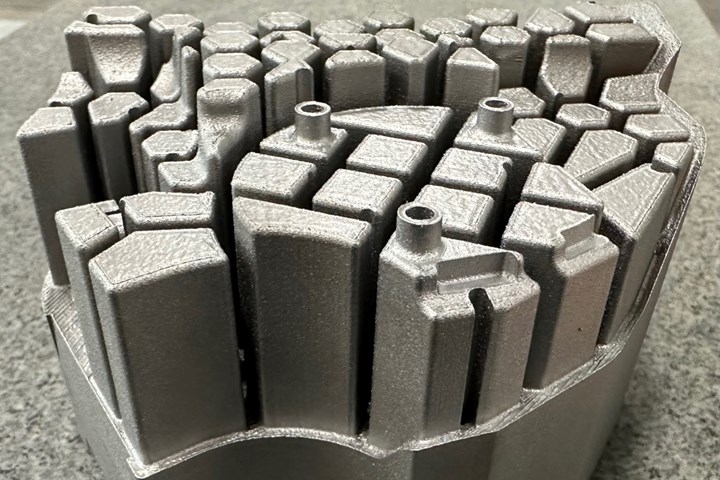
This core insert with conformal cooling channels was printed from HTC-45 powder.
Photo Credit: Next Chapter Manufacturing
Related Content
-
Mouldpro Mold Maintenance Tools, Gate Cutters Enable Improved Productivity
Mouldpro offers a variety of soft tools and gate cutters that are constructed to ensure molders can safely work on mold tools without damaging the mold surface.
-
Hot Show for Cold Jet
Dry ice blasting technology supplier Cold Jet has sold two of its show display machines at NPE2024.
-
Get Better at Using Foam for Your Molded Parts
Machine performance and process speeds are critical when using foam to reduce part weight while retaining part integrity.


