
Time to Automate Your Insert Molding Job? Answer these questions first
The benefits of automation—precision, repeatability, speed—are particularly suited to insert molding, but only if you heed the insert’s desires.


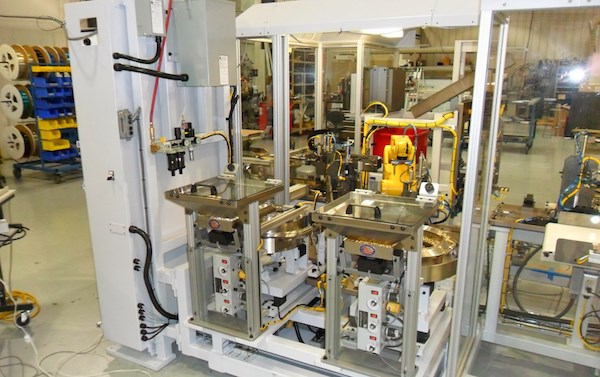
Wayne Gibson of automation system designer and manufacturer Pro Systems LLC, Churubusco, Ind., has consistently seen one problem area arise in automating insert molding operations, and he had some simple advice for his audience.


“Let a part be fed they way it wants to be fed,” Gibson said, “I’ve seen cell after cell where there are feeding issues.”
Gibson was a presenter at injection molding and automation supplier Engel’s recent symposium held at its Technical Center in Corona, Calif. Pro Systems has worked with the Austrian machine supplier on a number of installations, with more than a few of Engel’s vertical injection molding machines tasked with insert molding jobs domestically.
Prior to automating, Gibson offered up a list of project assessment questions molders should answer, including:
- Production volume
- Molding cycle time and overall cycle time
- Mold cavity matrix/layout
- Machine selection
- Type of runner system
In addition, Gibson said molders looking to build a cell around an insert molding job should consider:
- How are inserts presented to the cell (bulk, trays, conveyor, tubes, reel, bandolier)
- Orientation requirements
- Handling, feeding
- Measurement/Inspection/Verification requirements
It’s during this process that molders should consider the preferred orientation of the insert and how it needs be positioned within the mold to make sure they’re not, “stepping over dollars to get to pennies.” If tool steel hasn’t been cut, for example, the mold could be designed around the insert’s preferred orientation.
Gibson also noted that some jobs are best suited for the original automation solution, human operators, who, in some instances, can save you some dollars vs. pennies. He recounted a recent job where the cell as required would have cost enough to hire on 10 new operators.
“I’ve been doing automated cells for a long time,” Gibson said, “but there are still a lot of things that only an operator can do.”
Related Content
-
Ensuring Repeatability: The Key to Effective Injection Molding Automation
One of automation’s key promises is repeatability: the same movement to the same location, time and time again. But to achieve that, all elements involved — robot, machine, EOAT, mold — must be in and stay in alignment.
-
BMW Group Vehicle to Adopt 3D Printed Center Console
A vehicle coming to market in 2027 will include a center console carrier manufactured through polymer robot-based large-format additive manufacturing (LFAM).
-
Scaling New Heights With Vertical Integration
Eden Manufacturing was founded on a vision of vertical integration, adding advanced injection molding capabilities to a base of precision moldmaking and more recently bringing Swiss-type machining capabilities in-house.


