
A Look at the Re|focus Sustainability & Recycling Summit
Highlights from the summit include discussing PCR in packaging; Materials Recovery for the Future project and healthcare plastics recycling.


Aveda’s Edmond Irizarry delivered the keynote during the 2019 Re|focus Sustainability & Recycling Summit where he discussed the company’s use of PCR in packaging and beyond.
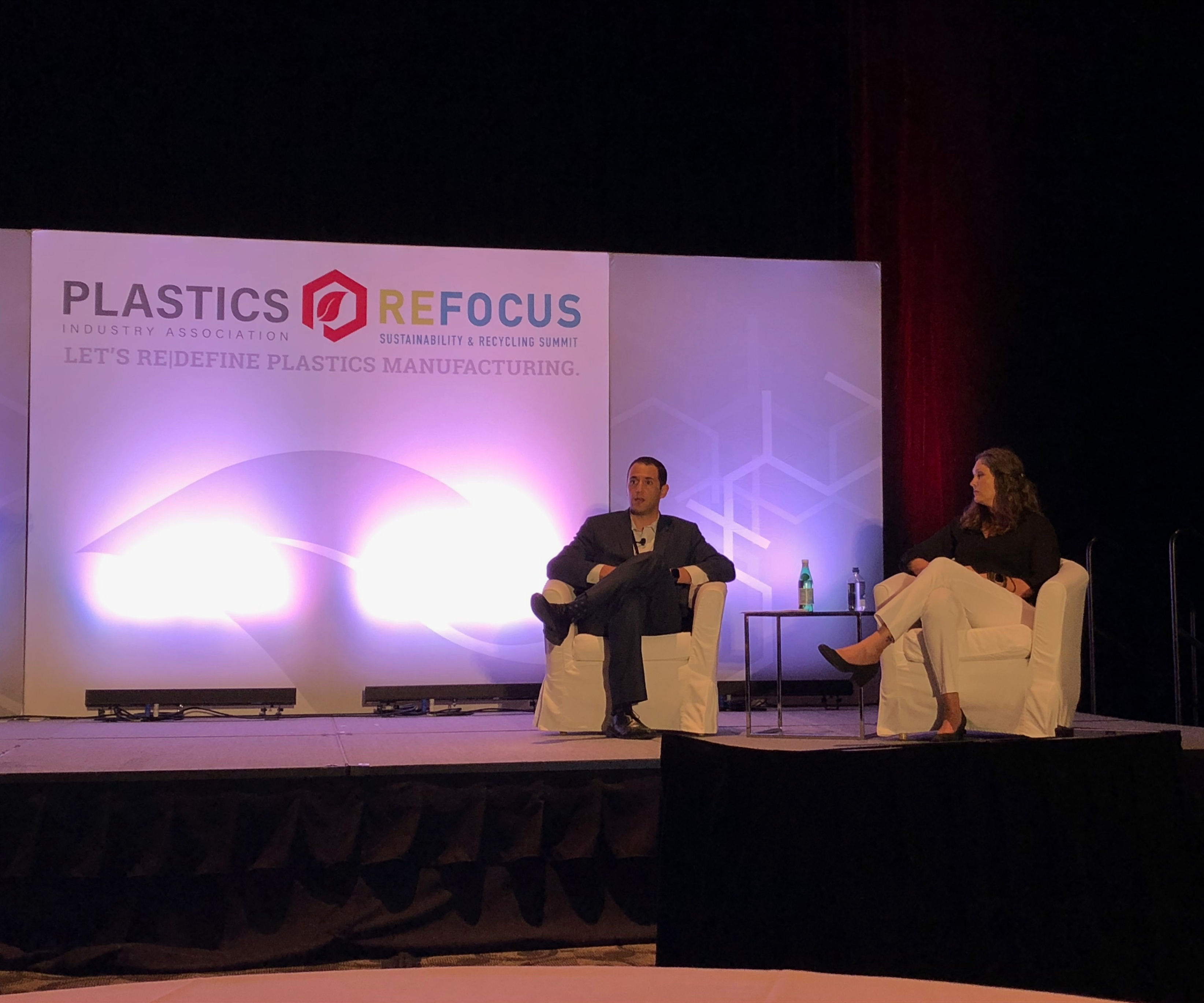
Aveda’s Edmond Irizarry and PLASTICS’ Kim Holmes during the 2019 Re|focus Summit.


Leaders across the sustainability supply chain gathered in Grand Rapids, Mich. (May 20-22), for the 2019 Re|focus Sustainability & Recycling Summit, presented by the Plastics Industry Association (PLASTICS).
This year’s summit keynote speaker was Edmond Irizarry, executive director of packaging development for Aveda, a cosmetics brand. Kim Holmes, vice president of sustainability at PLASTICS, said that Aveda is a “great example of using PCR and not compromising your brand or customer expectations.”


Aveda was the first beauty company to use 100% post-consumer recycled PET. Now more than 85% of its skin care and hair styling PET bottles and jars contain 100% post-consumer recycled materials. And its retail HDPE bottles are made in 100% PCR resin.
Another big initiative included pioneering the first rigid plastic cap recycling program in the U.S. in 2008. Irizarry says that they wanted to create a supply of material to use in some of its products. Working with KW Plastics, this lead to the development of a new grade of polypropylene (PP) PCR resin that is used throughout the industry today. Other initiatives include giving a second life to recycled plastics recovered from the beauty industry—such as taking recycled ABS resin pellets to produce a pencil sharpener; maximizing the use of recycled PP in its caps and brushes and becoming the first beauty company to combine PCR and bioplastic (plastic derived from sugarcane) in a plastic tube.
Irizarry says that future goals include phasing out the use of virgin plastics; expanding the usage of recycled resin in its packaging and developing a segment of refillable cosmetics.
Capturing Value from Recycling
Diane Herndon, senior manager of sustainability for the Nestlé Purina PetCare Co., discussed the company’s involvement in the Materials Recovery for the Future (MRFF) project, which focuses on recycling flexible packaging curbside and capturing value from it. MRFF has a partnership with J.P. Mascaro & Sons Inc. to pilot single-stream curbside recycling of flexible plastic packaging (FPP) at its TotalRecycle materials recovery facility (MRF) in Berks County, Penn., which started up about a month ago. This will be the first pilot to demonstrate the technical and economic feasibility of recycling household FPP from municipal residential single stream recycling programs.
“We hope it will provide a roadmap for other MRFs and eventually include more MRFs around the country,” Herndon said.
Healthcare Plastics Recycling
Healthcare plastics faces many of the challenges that consumer packaging faces and some other issues too, says Peylina Chu, vice president at Antea Group and also serves as the Executive Director of the Healthcare Plastics Recycling Council (HPRC). Estimates indicate that there are about 1 million tons of clean, non-infectious healthcare plastics generated in U.S. healthcare facilities each year. While the potential of this largely untapped waste stream is obvious; how to access this waste stream is less clear.
The HPRC recently launched the Healthcare Plastics Guide for Recyclers to help inform and educate plastics recyclers and processors about the common streams of plastic waste generated in clinical settings.
This guide includes:
- The most commonly generated healthcare plastic waste streams.
- How to partner with hospitals for a successful recycling program.
- Recycling options, including common steps in mechanically processing healthcare plastics.
- Case studies and other helpful resources.
- Technical specifications for common healthcare plastics.
Other HPRC project initiatives include its flexibles projects, which will determine viable strategies for recycling multi-material flexible plastic packaging currently being discarded as hospital waste. Working with researchers at the Plastics Engineering Department at the University of Massachusetts Lowell (UMass Lowell), the project will test whether commercially available compatibilizers improve blend properties when compounded with these multi-material flexible plastics. Additionally, through these blending trials and material analysis, the project aims to identify potential end market applications for the recycled product.


Related Content

For Extrusion and Injection-Blow Molders, Numerous Upgrades in Machines and Services
Uniloy is revising its machinery lines across the board and strengthening after-sales services in tooling maintenance, spare parts and tech service.
Read More
Breaking the Barrier: An Emerging Force in 9-Layer Film Packaging
Hamilton Plastics taps into its 30-plus years of know-how in high-barrier films by bringing novel, custom-engineered, nine-layer structures resulting from the investment in two new lines.
Read More
At NPE, Cypet to Show Latest Achievements in Large PET Containers
Maker of one-stage ISBM machines will show off new sizes and styles of handled and stackable PET containers, including novel interlocking products.
Read More
Multilayer Solutions to Challenges in Blow Molding with PCR
For extrusion blow molders, challenges of price and availability of postconsumer recycled resins can be addressed with a variety of multilayer technologies, which also offer solutions to issues with color, processability, mechanical properties and chemical migration in PCR materials.
Read MoreRead Next

People 4.0 – How to Get Buy-In from Your Staff for Industry 4.0 Systems
Implementing a production monitoring system as the foundation of a ‘smart factory’ is about integrating people with new technology as much as it is about integrating machines and computers. Here are tips from a company that has gone through the process.
Read More
For PLASTICS' CEO Seaholm, NPE to Shine Light on Sustainability Successes
With advocacy, communication and sustainability as three main pillars, Seaholm leads a trade association to NPE that ‘is more active today than we have ever been.’
Read More