
Trex Starts Up Recycled LLDPE Compounds Business
Finding a way to close the recycling loop, Trex creates a new business venture.


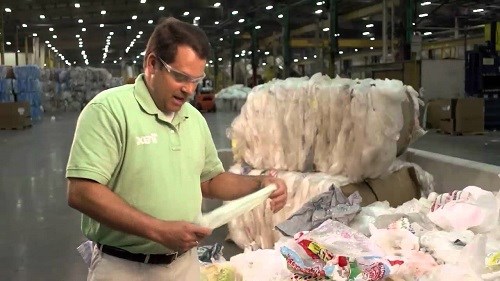


Trex Company has entered the recycled plastic compounds business. More specifically, the leading manufacturer of wood-alternative decking and railing and one of the largest recyclers of post-consumer and industrial polyethylene, has come up with a viable way to close the recycling loop by using its excess raw material to produce LLDPE pellets.
In fact, Trex’s entirely new business venture already has four lines dedicated to recycled pellet production, making it one of the country’s largest producers of recycled LLDPE, and has plans to add several more lines in the future.
According to senior director of material resources Dave Heglas, Trex’s engineering team leveraged its best-in-class recycling and extrusion capabilities, and using equipment downtime to experiment with and test different solutions, ultimately delivered a LLPDE pellet ideal for a variety of products. He envisions numerous applications for their recycled pellets, including a variety of bags, as well as molded products such as bins, totes, and even kayaks. He also see considerable potential in the manufacturing of both rigid and flexible tubing, such as agricultural drip tape.
The company is actively working with manufacturers across a wide range of industries—such as rotational molding, blown film, profile extrusion and material compounding—to explore additional uses for its LLDPE pellets. The company has the flexibility to modify and reformulate pellet content as needed to better fit specific needs, processes and applications.
Says Heglas, “Trex was literally built on sustainable principles and these continue to be at the heart of everything we do. With this new business, we are looking to partner with manufacturers that recognize the many benefits of using recycled materials and share our commitment to protecting the environment.”
A chemical engineer with a background in rocket science and missile design, Heglas joined Trex in 1996 as an engineer responsible for the raw materials and plastics processing side of the business. After a few years working with recycled materials, he saw opportunities and potential value in using and repurposing recycled plastic. In 2004, Heglas formalized the company’s recycling operations, an initiative which has evolved into a company within a company.
“Turning Trex from a company using recycled plastic into a plastic recycler was something that made perfect strategic sense. We were collecting way more than we needed or could ever use in our deck boards, so we began selling off some of the inventory to manufacturers in other industries,” says Heglas. Among those manufacturers were small companies that Trex contracted to produce plastic pellets.
Over time, it occurred to Heglas that Trex could be fabricating in-house rather than outsourcing to third parties. After nearly a decade of producing pellets for Trex internal use, the next logical step was to leverage the in-house expertise and expand capabilities to produce pellets for additional industries and markets. “We came to realize that we were the only company capable of producing LLDPE pellets in high volumes and with greater consistency. Previously, manufacturers had to rely on multiple sources for plastic pellets which meant unpredictable quantities and widely-varying product characteristics. With our extensive supply and equipment capacity, Trex is able to deliver the quantities and quality manufactures need at a lower price and with the added convenience of a single-source provider.”
Want to find or compare materials data for different resins, grades, or suppliers? Check out Plastics Technology’s Plaspec Global materials database.


Related Content

The Recycling Collaboration That Is Making Circular Film a Reality
Nova Chemicals and Novolex are commissioning a large mechanical recycling facility for film to film.
Read More
Get Color Changes Right In Extrusion Blow Molding
Follow these best practices to minimize loss of time, material and labor during color changes in molding containers from bottles to jerrycans. The authors explore what this means for each step of the process, from raw-material infeed to handling and reprocessing tails and trim.
Read More
Through Thick and Thin: Reflecting on Injection Molding Thin and Thick Walls
Author considers time molding thin-wall food packaging and thicker-walled interior automotive trim, weighing the differences and similarities in process, molds and materials.
Read More
Thin, High-Performance Nylon/PE Barrier Film for Thermoformed Packaging
Südpack’s Multifol Extreme film is well suited for greasy, protein-rich and frozen foods
Read MoreRead Next

For PLASTICS' CEO Seaholm, NPE to Shine Light on Sustainability Successes
With advocacy, communication and sustainability as three main pillars, Seaholm leads a trade association to NPE that ‘is more active today than we have ever been.’
Read More
People 4.0 – How to Get Buy-In from Your Staff for Industry 4.0 Systems
Implementing a production monitoring system as the foundation of a ‘smart factory’ is about integrating people with new technology as much as it is about integrating machines and computers. Here are tips from a company that has gone through the process.
Read More